If you’ve just started dipping your toes into the world of investing, you’ve probably heard the term ETF thrown around a lot.
“Buy ETFs for diversification.” “ETFs are safer than single stocks.” “Low-cost ETFs are the way to go.”
But what exactly is an ETF?
Don’t worry—you don’t need a finance degree to understand this. By the end of this post, you’ll know what an ETF is, how it works, and why millions of investors (including Warren Buffett) recommend them.
The Simple Definition
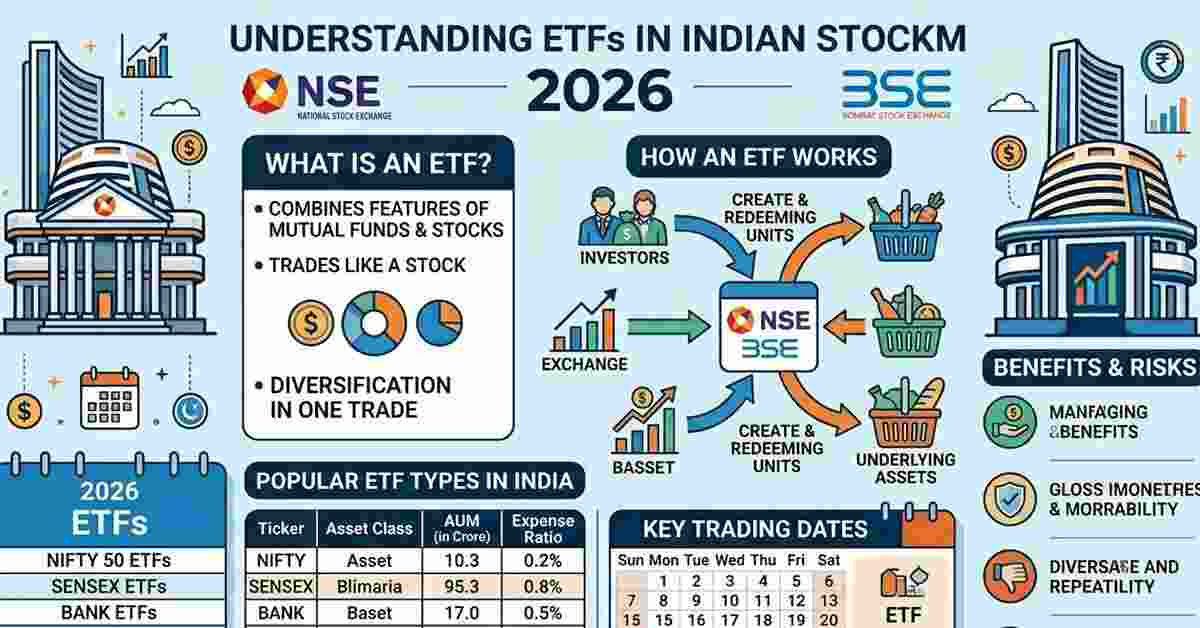
ETF stands for Exchange Traded Fund.
Let’s break that down:
- Fund: A basket of different assets (stocks, bonds, gold, etc.) grouped together.
- Exchange Traded: You can buy and sell that basket on a stock exchange (like the NYSE or Nasdaq), just like you would a regular stock like Apple or Tesla.
In plain English: An ETF is a bucket that holds dozens (or even hundreds) of different investments. When you buy one share of an ETF, you own a tiny piece of everything inside that bucket.
A Simple Analogy
Imagine you want to buy a classic rock music collection.
- Buying a single stock is like buying just one song (say, Bohemian Rhapsody). If that song gets old, you lose.
- Buying an ETF is like buying the entire Greatest Hits of Classic Rock album. You get Queen, Led Zeppelin, The Eagles, and Pink Floyd all at once. If one song flops, you still have the others.
The ETF is the album. You get diversification instantly.
How Does an ETF Actually Work?
Let’s look at a real-world example: SPY (the SPDR S&P 500 ETF).
- What’s inside? This ETF holds shares of the 500 largest companies in the U.S. (Apple, Microsoft, Amazon, Google, etc.).
- What happens when you buy? If you buy 1 share of SPY for roughly $450, you now own a tiny slice of all 500 companies.
- What happens next? If the S&P 500 goes up 10%, your ETF share likely goes up roughly 10%. If it goes down, you lose money too—but you won’t be wiped out by one bad company.
ETF vs. Mutual Fund: The Quick Comparison
Most people confuse ETFs with Mutual Funds. Here’s the difference:
| Feature | ETF | Mutual Fund |
|---|---|---|
| Trading time | Like a stock (trades instantly during market hours) | Trades once per day after markets close |
| Minimum investment | Price of 1 share (often $50–$500) | Often $1,000 – $3,000 |
| Fees | Very low (0.03% – 0.50%) | Can be higher (0.50% – 1.50%) |
| Active vs Passive | Mostly passive (track an index) | Often active (managed by a pro) |
Why Do Investors Love ETFs? (The 3 Big Benefits)
1. Instant Diversification (Lower Risk)
Instead of putting all your money into one company (like betting everything on Tesla), an ETF spreads your risk across 100+ companies. If one fails, it’s just a small scratch, not a crash.
2. Low Cost
Because most ETFs simply track an index (like the S&P 500 or Nasdaq) instead of paying expensive fund managers, their fees are tiny. Over 30 years, those low fees save you tens of thousands of dollars.
3. Flexibility
You can buy and sell ETFs anytime the stock market is open. Need cash fast? Sell your ETF at 1:00 PM and get your money in two days. You can’t do that with a mutual fund.
Are There Any Downsides?
Yes, nothing is perfect.
- Brokerage commissions: While most brokers (Robinhood, Fidelity, Schwab) now offer $0 commissions, some still charge a small fee per trade.
- You can lose money: An ETF is not a savings account. If the stock market crashes, your ETF value crashes too. Diversification reduces risk but does not eliminate it.
- Too many choices: There are over 3,000 ETFs in the U.S. alone. Some are great (S&P 500 funds). Some are weird and risky (3x leveraged crypto ETFs). You have to pick wisely.
The Best ETF for Absolute Beginners
If you have $100 to start investing today, here is the simplest, safest, smartest move:
Buy a “Total Stock Market ETF” or an “S&P 500 ETF.”
- VTI (Vanguard Total Stock Market) – Owns nearly every public company in America.
- VOO (Vanguard S&P 500) – Owns the 500 largest companies.
- SPY (SPDR S&P 500) – Same as VOO, slightly more popular for trading.
How to start:
- Open a brokerage account (Fidelity, Schwab, Robinhood, Vanguard).
- Deposit $100.
- Search for “VOO.”
- Click “Buy.”
- Congratulations—you now own a diversified portfolio.
Final Takeaway
An ETF is simply a basket of investments that trades like a stock. It gives you diversification, low costs, and simplicity all in one package.
You don’t need to pick winning stocks. You don’t need to time the market. You just need to buy a low-cost S&P 500 ETF, hold it for 10+ years, and let the economy do the work.
That’s the secret most wealthy people know—and now you know it too.