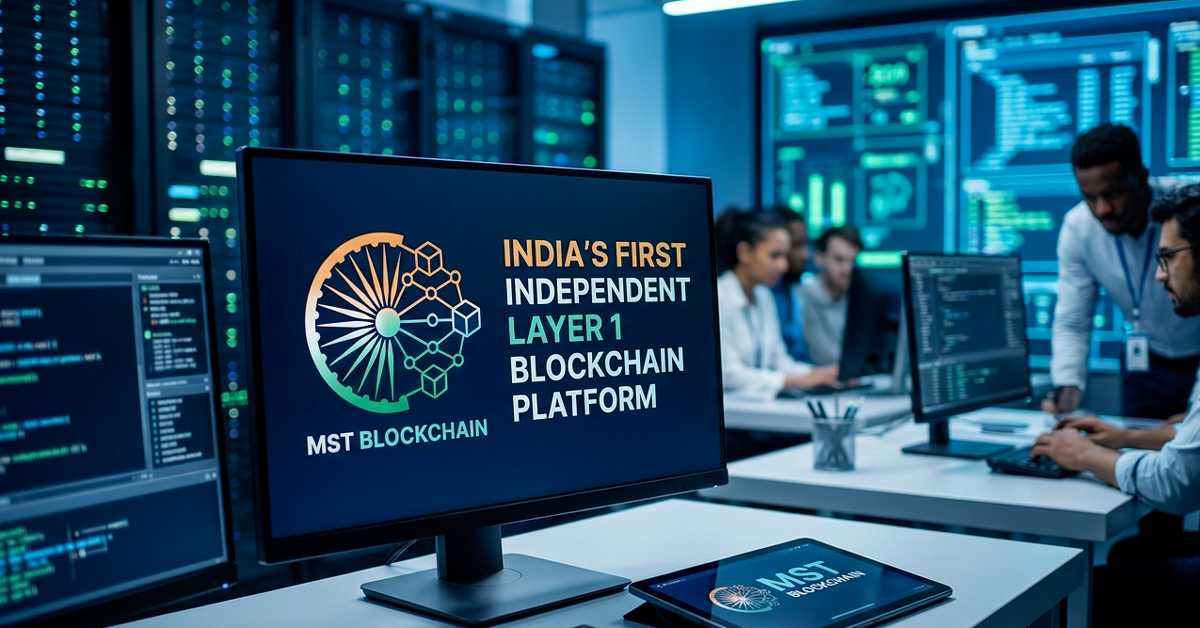
MST Blockchain (often called MST Chain) is India’s first independent Layer 1 blockchain platform, launched around 2024–2025. It positions itself as a public, decentralized, EVM-compatible network focused on mass adoption, real-world utility, low costs, scalability, and inclusivity—branded as “the People’s Blockchain.”
Key Highlights
- Type: Fully public Layer 1 blockchain (not a sidechain or Layer 2).
- Native Token: MSTC (utility token for fees, staking, governance, and rewards).
- Consensus: Primarily uses Proof of Staked Authority (PoSA) — a hybrid that combines elements of Proof of Authority (for speed/efficiency) and Delegated Proof of Stake (for decentralization and governance). It achieves fast finality with ~3-second block times and high throughput (reported 2,000+ TPS, with testnet figures up to ~2,234 TPS and ambitions for 4,000+ on mainnet).
- Compatibility: EVM-compatible, so developers can easily port Ethereum dApps using tools like Solidity, Hardhat, and MetaMask. It also plans support for WebAssembly (WASM) and cross-chain features.
Unique Features
- Fractional Node Economy: One of its standout aspects — users can buy “fractions” of validator nodes (no-code participation) to help secure the network and earn MSTC rewards without running full hardware. This lowers the barrier for ordinary people to become validators. Node fractions are currently priced around ₹2,900–3,000 INR (~$32 USD) plus taxes via their portal.
- Tokenomics Inspired by Bitcoin: No pre-mined allocations or team reserves. MSTC is earned mainly through validation/staking. Genesis supply was 50 billion, but a large burn in late 2024 reduced circulating supply to roughly 8.4 billion MSTC. Emission is disinflationary (starts at 200 MSTC per block and halves periodically), aiming for scarcity and long-term value stability.
- User-Friendly Tools:
- SARAL Protocol: Simplifies onboarding with non-custodial MPC (Multi-Party Computation) key management — like easy Web2-style login but secure for Web3.
- MST Buddy: An AI assistant for on-chain queries and guidance.
- BridgeKey Wallet: Their official non-custodial wallet.
- WASMify & other protocols: ZK-powered tools for secure real-world data integration, provably fair gaming (e.g., FortunaX for randomness), etc.
- Security Focus: Quantum-ready cryptography, AI-driven identity layers, slashing for bad validator behavior, and transparent on-chain governance via DAO (using OpenZeppelin-style Governor contracts).
- Developer Support: Grants program (up to $500K) for builders, detailed docs, and ecosystem incentives.
Use Cases and Ecosystem
MST Blockchain targets real-world adoption rather than pure speculation. Examples include:
- Supply chain traceability
- Tokenized real-world assets (RWAs)
- DeFi
- NFTs
- Gaming (provably fair mechanics)
- Retail loyalty programs
- Enterprise smart contracts
- Digital identity and governance
It has partnerships (e.g., with SafePal for wallets, IDfy for KYC) and claims growing metrics like 55,000+ validators and 157,000+ active wallets. There’s also an education push in Indian colleges and community events.
Note on MSTC Trading: As of early 2026, MSTC does not appear to be widely listed on major centralized or decentralized exchanges yet, so liquidity and price data are limited or unavailable on major trackers. Always check the official block explorer (mstscan.com) for on-chain activity.
MST Blockchain is Building India’s Crypto Future
- Founded: 2024, headquartered in Pune, Maharashtra, India. The team describes itself as visionary developers and entrepreneurs focused on decentralization.
- It emphasizes transparency (public validators, no hidden allocations) and has a whitepaper on GitHub detailing the architecture.
- Like many newer Layer 1 projects, it has community hype (Instagram, YouTube, events like IGNITE 2026) but also some skepticism in forums (e.g., Reddit discussions questioning if it’s legit or high-risk).
Important: Cryptocurrency and blockchain projects carry high risk. MST Blockchain is relatively new, and while it claims strong decentralization and utility focus, do your own research (DYOR). Review the official whitepaper, smart contracts, and team transparency before participating (especially in node purchases or staking). Check for regulatory compliance in your region (India has evolving crypto rules).
Official Resources:
- Website: https://mstblockchain.com/
- Portal (for nodes/wallet linking): https://mstblockchain.com/portal/
- Explorer: https://mstscan.com
- Whitepaper: Available on their GitHub
- Docs: docs.mstblockchain.com
If you’re interested in specific aspects (like how to set up a wallet, run a node, or developer tools), let me know for more details! Always verify links and never share private keys.
1 thought on “What is MST Blockchain? Complete Beginner’s Guide to India’s First Public Layer 1 Blockchain in 2026”